

A stack of glued glass sheets showing light penetration and scattering. Photo credit: Marcelle Deichev
From materials that can be bonded and undone on command to new ways of designing antibiotics, diagnosing disease, and capturing carbon, researchers at the Hebrew University of Jerusalem made discoveries over the past year that push the boundaries of science and innovation. Here are ten breakthroughs from 2025 that blend curiosity-driven research with real-world relevance.
1. The adhesive that bonds on command – and comes apart just as easily
Researchers led by Prof. Shlomo Magdassi of the Hebrew University of Jerusalem, together with Prof. Hanna Dodiuk of Shenkar College, and PhD student Natanel Jarach developed a new adhesive that resolves a long-standing challenge: combining strength with sustainability.
The material bonds rapidly under visible light to glass, plastic, and metals – even underwater – yet can be cleanly taken apart using a household microwave. Reusable and solvent-free, the adhesive opens the door to recyclable electronics, sustainable packaging, optical components, and even reversible biomedical applications
2. A new way to design antibiotics in the fight against resistance
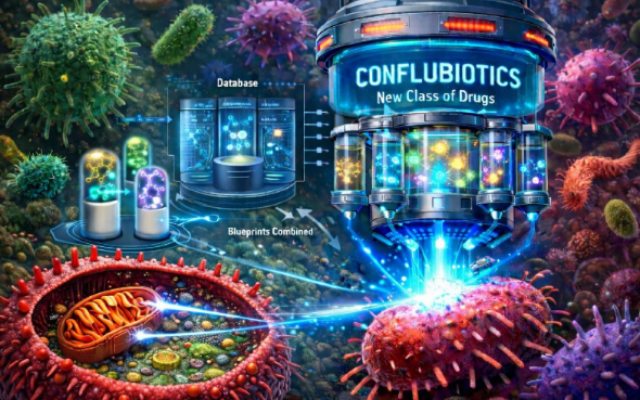
Graphic, non-representative illustration provided by the researchers
Researchers led by Prof. Dmitry Tsvelikhovsky of the Hebrew University of Jerusalem’s Institute for Drug Research have developed a new strategy for designing antibiotics by treating existing drugs as molecular “blueprints” that guide the creation of entirely new antibacterial compounds. The approach, known as Conflubiotics, focuses on identifying and combining key bioactive structural domains from different antibiotic families into single, newly designed hybrid molecules.
Drawing on a proprietary database of more than 300 known antibiotics, the method enables systematic exploration of hundreds of novel antibacterial entities that bacteria have never encountered.
Early results show that some of these compounds operate through previously unexploited mechanisms and, in several cases, display greater potency than the antibiotic classes from which their active domains are derived. At a time when antibiotic resistance is accelerating and traditional discovery pipelines have stalled, this blueprint-based strategy offers a promising new direction for the development of future antibacterial therapies.
3. Is the secret to beating the flu hidden in chocolate?

A study led by Prof. Isaiah (Shy) Arkin of the Hebrew University of Jerusalem revealed that theobromine, a compound found in chocolate, combined with another molecule, arainosine, outperformed Tamiflu in fighting even the deadliest flu strains in lab and animal tests.
By targeting a weakness in the virus’s ion channel, the approach didn’t just slow the flu – it stopped it. Because many viruses rely on similar channels, the discovery could inform future antiviral treatments.
4. Could a simple blood test change how Parkinson’s is diagnosed?
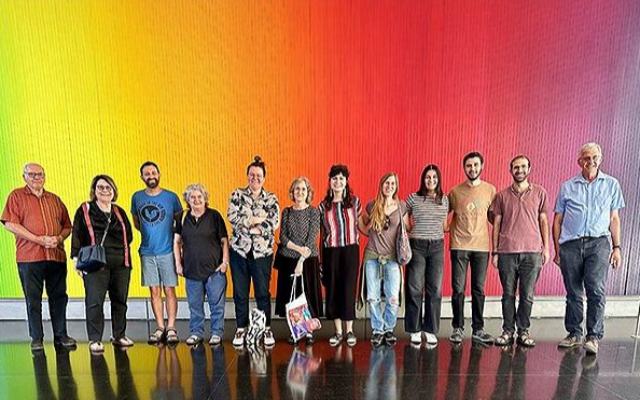
Hebrew University researchers behind an innovative tool for diagnosing Parkinson’s
Scientists at the Hebrew University developed a blood test that can identify Parkinson’s disease years before symptoms appear. The research was led by PhD student Nimrod Madrer, under the supervision of Prof. Hermona Soreq, at the Edmond and Lily Safra Center for Brain Sciences (ELSC) and the Alexander Silberman Institute of Life Sciences.
By analyzing RNA in the blood, the test measures the ratio between two molecular markers linked to disease progression. The result is a fast, non-invasive, and highly accurate diagnostic tool – offering the possibility of earlier detection and better long-term care.
5. Strengthening cells’ defenses against Alzheimer’s

Researchers at the Hebrew University of Jerusalem, led by Prof. Ehud Cohen together with Huadong Zhu and Dr. Yonatan Tzur, uncovered a new way cells communicate to protect themselves from the protein damage linked to neurodegenerative diseases such as Alzheimer’s.
The study shows that dialing down the activity of a specific cellular complex helps cells coordinate the maintenance of healthier protein network and reduces the toxic effects of Alzheimer’s-related proteins in model organisms. This supports the cell’s natural “protein quality control” system.
The findings shed light on key processes behind neurodegeneration and open new directions for research into healthy aging.
6. Borrowing nature’s blueprint to capture carbon

Carbon capture illustration Credit: Based on Avihai Tenenbaum’s illustration, created with AI tools
Noga Moran and Dr. Yonaton Goldsmith of the Hebrew University of Jerusalem, together with Dr. Eyal Wargaft of the Israeli Open University, found a way to dramatically speed up one of nature’s key processes for removing carbon dioxide from the atmosphere—compressing a process that normally takes thousands of years into just hours.
By running carbon dioxide and seawater through columns filled with limestone and dolomite, the team demonstrated how carbon can be captured and stored in a stable, dissolved form rather than released into the air, providing a nature-based approach for reducing industrial emissions.
7. When light acts like a magnet

Faraday. Credit: Enrique Sahagún
Researchers at the Hebrew University of Jerusalem, led by Dr. Amir Capua and Benjamin Assouline from the Institute of Electrical Engineering and Applied Physics, have shown that light can influence materials magnetically in ways long thought negligible.
The study demonstrates that the magnetic component of light plays a direct role in the Faraday Effect, in which the polarization of light rotates as it passes through certain crystals in a magnetic field. Rather than being a passive byproduct, the magnetic field of light contributes directly to this process, revealing magnetic properties of the material itself.
The findings offer new insight into how light interacts with matter and could inform future developments in optical technologies, spintronics, and light-based control of magnetic systems, including emerging quantum applications.
8. Whale song has language-like structure

Humpback whales communicate through complex songs that share surprising similarities with human language. Credit: Mark Quintin
Humpback whale song, one of the most striking examples of animal communication, turns out to follow some of the same hidden rules as human language.
An international research team analyzed eight years of humpback whale song recordings from New Caledonia. They identified recurring sequences of sound whose frequencies follow the same distinctive statistical pattern found for words across all known human languages – a pattern never before observed in a non-human species.
The study was co-led by Professor Inbal Arnon of the Hebrew University of Jerusalem and suggests that socially learned communication systems can develop similar structures even across vastly different species. Listen to an example of humpback whale song here.
9. How early sound shapes the brain – differently for males and females

A new study from the Hebrew University of Jerusalem shows that sounds heard in early life can shape long-term sound preferences, and that males and females respond in strikingly different ways. The research was led by Kamini Sehrawat together with Prof. Israel Nelken of the Hebrew University of Jerusalem.
When young mice were exposed to structured sounds, artificial noise, or silence, male mice showed lasting changes in their later sound preferences, while female mice were less influenced by early exposure. Furthermore, the study suggests that different brain areas control sound preferences in male and female mice.
The study highlights how early exposure to sound can leave a lasting imprint on brain development, with implications for understanding learning, emotion, and sensitivity to early environments.
10. A Roman-era crime, revealed on papyrus

Credit: Shai Halevi, courtesy of the Leon Levy Dead Sea Scrolls Digital Library, Israel Antiquities Authority
Researchers helped uncover an extraordinary criminal case from the Roman Empire, preserved on the longest Greek papyrus ever found in the Judaean Desert (comprising over 133 lines of text) and published for the first time.
Dating to the early 2nd century CE, the document records prosecutors’ notes from a Roman trial involving tax fraud, forged documents, and the illegal sale and manumission of slaves. Written in vivid, direct language, it offers a rare look at how Roman justice operated far from Rome itself.
Rediscovered in the Israel Antiquities Authority’s scrolls laboratory and identified by Prof. Hannah Cotton Paltiel, emerita of the Hebrew University, the papyrus sheds new light on daily life and legal practice on the eve of the Bar Kokhba revolt.
With thanks to Yissum, the Tech Transfer and Research Development Company of the Hebrew University of Jerusalem, and to the University’s Division of Marketing and Communications for their invaluable support.
For a century, the Hebrew University of Jerusalem has been a beacon for visionary minds who challenge convention and shape the future. Founded by luminaries like Albert Einstein, who entrusted his intellectual legacy to the university, it is dedicated to advancing knowledge, cultivating leadership, and promoting diversity. Home to over 23,000 students from 90 countries, the Hebrew University drives much of Israel’s civilian scientific research and the commercialization of technologies through Yissum, its tech transfer company. Hebrew University’s groundbreaking contributions have been recognized with major international awards, including ten Nobel Prizes, two Turing Awards, and a Fields Medal. Ranked 88th globally by the Shanghai Ranking (2025), Hebrew University marks a century of excellence in research, education, and innovation. To learn more about the university’s academic programs, research, and achievements, visit the official website at http://new.huji.ac.il/en